2 Pole DC Circuit Breaker 20A MCB 500V Non-Polarised
$53.99 inc GSTFast, safe, and reliable 2 pole DC circuit breaker for professional electrical projects up to 500V.

DC circuit breakers provide essential circuit protection for direct current electrical systems in solar installations, marine applications, automotive systems, and industrial equipment. Unlike AC breakers, DC circuit breakers are specifically engineered to handle the unique arc suppression challenges of direct current, where the continuous current flow makes interruption more difficult.
At iSupply Electrical, we supply a comprehensive range of DC circuit breakers designed for various voltage ratings and current capacities, from low-voltage automotive applications to high-voltage solar PV systems. Our inventory includes miniature circuit breakers (MCBs), moulded case circuit breakers (MCCBs), and specialized DC-rated breakers suitable for off-grid power systems, battery banks, electric vehicle charging infrastructure, and renewable energy installations.
Licensed electricians and contractors working on solar installations, marine electrical systems, or industrial DC applications rely on our DC circuit breakers to meet Australian safety standards while protecting valuable equipment from overcurrent conditions. We stock products from trusted manufacturers that comply with relevant Australian and international standards for DC circuit protection.
Whether you’re installing rooftop solar arrays, servicing marine electrical systems, or maintaining industrial DC machinery, our DC circuit breaker range delivers the reliable protection your projects demand. Browse our selection online or contact our Fairfield East location for technical specifications and trade pricing on bulk orders.
DC circuit breakers are specifically designed to interrupt direct current, which creates a sustained arc that’s harder to extinguish than alternating current. DC breakers use enhanced arc suppression mechanisms and different contact materials to safely break DC circuits, while AC breakers rely on the natural current zero-crossing in alternating current. Never substitute an AC-rated breaker in a DC application, as it may fail catastrophically.
DC circuit breakers are available in various voltage ratings including 12V, 24V, 48V for automotive and low-voltage systems, 125V and 250V for industrial applications, and higher voltages up to 1000V or 1500V for solar PV systems and energy storage installations. Always select a breaker with a voltage rating equal to or greater than your system’s maximum operating voltage.
DC circuit breakers are essential for solar photovoltaic systems, battery energy storage systems, marine electrical installations, electric vehicle charging stations, telecommunications equipment, data centers with DC power distribution, railway systems, and industrial machinery operating on direct current. They provide critical circuit protection in any system where DC power is generated, stored, or distributed.
Size DC circuit breakers based on the maximum continuous current of your solar array or battery bank, typically 125% of the maximum operating current. Consider the system voltage, short-circuit current rating, and temperature derating factors. For solar PV strings, calculate based on the module’s short-circuit current multiplied by the number of parallel strings, ensuring the breaker’s interrupting capacity exceeds potential fault currents.
For most DC systems, you need separate circuit protection on both the positive and negative conductors, or a double-pole DC breaker that simultaneously disconnects both. Single-pole breakers are suitable only when one conductor is grounded and the breaker is installed on the ungrounded conductor. Australian solar installation standards typically require disconnection of both poles for safety and maintenance isolation.
We carry DC circuit breakers from reputable manufacturers that meet Australian standards for circuit protection in DC applications. Our range includes products suitable for residential solar installations through to industrial DC distribution systems. Contact us for specific brand availability and technical datasheets for your project requirements.
Showing all 7 results

Fast, safe, and reliable 2 pole DC circuit breaker for professional electrical projects up to 500V.

A rugged 20A 2 pole DC MCB circuit breaker with a waterproof IP66 enclosure, built for safe, compliant DC protection in demanding environments.
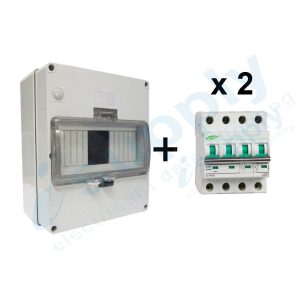
20A 2 x 4 Pole MCB DC1000V (Non polarised) 8 pole Waterproof Enclosure Non-Polarised 4 Pole 1000V DC Circuit Breaker and CE Approved, IP66 Rated, CB Tested, Lockable, Metal Mounting Plate included, M25x1.5 Thread, ( Top x 1 Bottom x 2). Non Polarised 1000V 20A DC Breaker meets the new Australian Standard AS/NZ5033 . *SAA…

Non-Polarised 4 Pole 1000V DC Circuit Breaker Non-Polarised 4 Pole 1000V DC Circuit Breaker The Clipso Non Polarised 1000V 20A DC Breaker meets the new Australian Standard AS/NZ5033 . *SAA Approved* Tax Invoice Included SAA Compliance Certificate Complies with AS/NZ4417 Loadable string protection up to 63A German mechanism – no heating or arching Contacts –…

Non-Polarised 4 Pole 1000V DC Circuit Breaker and Waterproof Enclosure Non-Polarised 4 Pole 1000V DC Circuit Breaker and CE Approved, IP66 Rated, CB Tested, Lockable, Metal Mounting Plate included, M25x1.5 Thread, ( Top x 1 Bottom x 2). The Clipso Non Polarised 1000V 20A DC Breaker meets the new Australian Standard AS/NZ5033 . *SAA Approved*…

Non-Polarised 4 Pole 500V DC Circuit Breaker Non Polarised 500V 20A DC Breaker meets the new Australian Standard AS/NZ5033. *SAA Approved* Tax Invoice Included SAA Compliance Certificate Complies with AS/NZ4417 Loadable string protection up to 63A German mechanism – no heating or arching Contacts – 50% Silver 50% Copper Need bulk quantity? Contact us for…
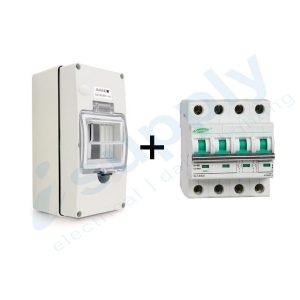
Non-Polarised 4 Pole 1000V DC Circuit Breaker and Waterproof Enclosure Non-Polarised 4 Pole 1000V DC Circuit Breaker and CE Approved, IP66 Rated, CB Tested, Lockable, Metal Mounting Plate included, M25x1.5 Thread, ( Top x 1 Bottom x 2). The Clipso Non Polarised 1000V 25A DC Breaker meets the new Australian Standard AS/NZ5033 . *SAA Approved*…
DC circuit breakers provide essential circuit protection for direct current electrical systems in solar installations, marine applications, automotive systems, and industrial equipment. Unlike AC breakers, DC circuit breakers are specifically engineered to handle the unique arc suppression challenges of direct current, where the continuous current flow makes interruption more difficult.
At iSupply Electrical, we supply a comprehensive range of DC circuit breakers designed for various voltage ratings and current capacities, from low-voltage automotive applications to high-voltage solar PV systems. Our inventory includes miniature circuit breakers (MCBs), moulded case circuit breakers (MCCBs), and specialized DC-rated breakers suitable for off-grid power systems, battery banks, electric vehicle charging infrastructure, and renewable energy installations.
Licensed electricians and contractors working on solar installations, marine electrical systems, or industrial DC applications rely on our DC circuit breakers to meet Australian safety standards while protecting valuable equipment from overcurrent conditions. We stock products from trusted manufacturers that comply with relevant Australian and international standards for DC circuit protection.
Whether you’re installing rooftop solar arrays, servicing marine electrical systems, or maintaining industrial DC machinery, our DC circuit breaker range delivers the reliable protection your projects demand. Browse our selection online or contact our Fairfield East location for technical specifications and trade pricing on bulk orders.
DC circuit breakers are specifically designed to interrupt direct current, which creates a sustained arc that’s harder to extinguish than alternating current. DC breakers use enhanced arc suppression mechanisms and different contact materials to safely break DC circuits, while AC breakers rely on the natural current zero-crossing in alternating current. Never substitute an AC-rated breaker in a DC application, as it may fail catastrophically.
DC circuit breakers are available in various voltage ratings including 12V, 24V, 48V for automotive and low-voltage systems, 125V and 250V for industrial applications, and higher voltages up to 1000V or 1500V for solar PV systems and energy storage installations. Always select a breaker with a voltage rating equal to or greater than your system’s maximum operating voltage.
DC circuit breakers are essential for solar photovoltaic systems, battery energy storage systems, marine electrical installations, electric vehicle charging stations, telecommunications equipment, data centers with DC power distribution, railway systems, and industrial machinery operating on direct current. They provide critical circuit protection in any system where DC power is generated, stored, or distributed.
Size DC circuit breakers based on the maximum continuous current of your solar array or battery bank, typically 125% of the maximum operating current. Consider the system voltage, short-circuit current rating, and temperature derating factors. For solar PV strings, calculate based on the module’s short-circuit current multiplied by the number of parallel strings, ensuring the breaker’s interrupting capacity exceeds potential fault currents.
For most DC systems, you need separate circuit protection on both the positive and negative conductors, or a double-pole DC breaker that simultaneously disconnects both. Single-pole breakers are suitable only when one conductor is grounded and the breaker is installed on the ungrounded conductor. Australian solar installation standards typically require disconnection of both poles for safety and maintenance isolation.
We carry DC circuit breakers from reputable manufacturers that meet Australian standards for circuit protection in DC applications. Our range includes products suitable for residential solar installations through to industrial DC distribution systems. Contact us for specific brand availability and technical datasheets for your project requirements.
Looks like you haven't made a choice yet.